Queue Management System in Saudi Arabia: 7 Benefits Retailers Need in 2026
Long lines at a bank branch, a government office, or a busy retail counter in Riyadh or Jeddah are no longer acceptable to customers who expect fast, digital service. A modern queue management system in Saudi Arabia replaces the paper ticket and the shouting match at the counter with a calm, data-driven flow that keeps customers informed and staff productive. This guide breaks down why queue systems matter now, what they cost, and how to choose the right setup for your branch network in 2026.
Saudi Arabia’s retail and service sector has grown fast under Vision 2030, and customer expectations have grown with it. Shoppers compare their experience at a mobile operator counter to the experience they get at an airport lounge or a five-star hotel. If your branch still relies on a first-come-first-served scrum at the door, you are losing customers to competitors who invested in a proper queueing solution.
Why Saudi Businesses Are Switching to Digital Queue Management in 2026
The shift is not cosmetic. Businesses that install digital queueing report measurable drops in walkouts and complaints within the first month. Three forces are driving adoption across the Kingdom this year.
Rising customer expectations
Saudi consumers are some of the most mobile-first shoppers in the region. They expect to check wait times on their phone before they even leave home, book a virtual ticket, and arrive just as their turn approaches. A queue system that cannot offer SMS or app-based ticketing simply cannot compete.
Staff efficiency pressure
Labor costs are rising, and branch managers are under pressure to serve more customers with the same headcount. Automated queue routing sends each customer to the right counter the first time, cutting the back-and-forth that wastes staff hours every single day.
Core Components of a Queue Management System in Saudi Arabia
Most deployments across Saudi retail, healthcare, and government service centers share the same building blocks. Understanding each piece helps you plan a budget and a rollout timeline that will not surprise you later.
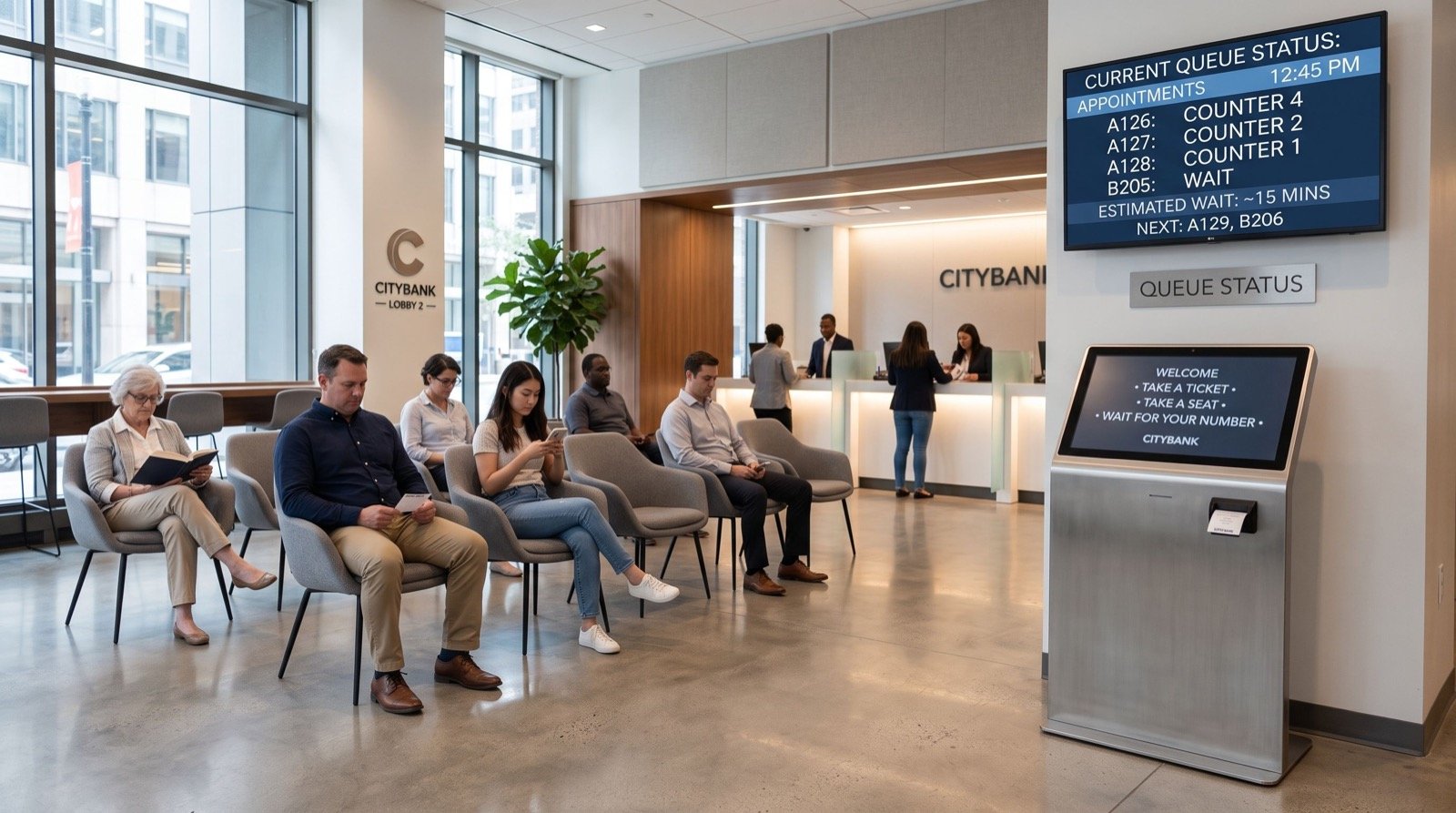
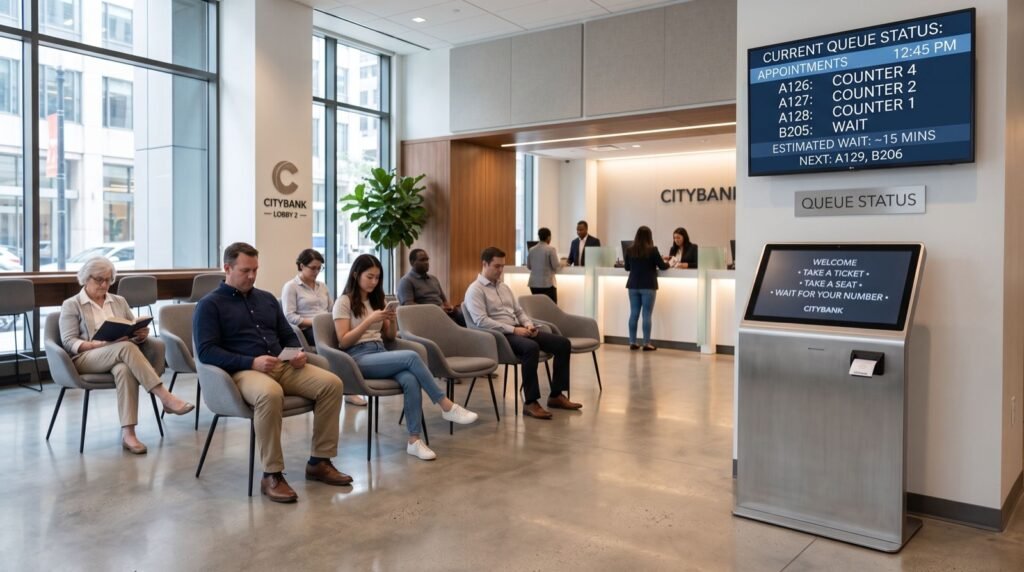
- Ticket kiosk — a touchscreen or token dispenser where customers select a service and receive a number.
- Display screens — wall-mounted monitors showing the current number being served at each counter.
- Counter terminals — small devices or software at each staff desk to call the next customer.
- Central server or cloud dashboard — the brain that routes tickets, logs wait times, and generates reports.
- Mobile/SMS integration — optional but increasingly expected, letting customers track their position remotely.
For organizations that already run multiple branches, a cloud-hosted dashboard is worth the extra cost. It lets a regional manager in Riyadh compare average wait times across Jeddah, Dammam, and Medina branches from a single screen, which is invaluable for staffing decisions.
Choosing a Vendor: What Actually Matters
Many businesses choose a vendor based on price alone and regret it within six months when the hardware fails or the software cannot integrate with their point-of-sale system. Look instead at the full picture.
| Factor | Why It Matters | What To Ask The Vendor |
|---|---|---|
| Local support | Hardware fails; you need same-week repair, not a shipment from overseas | Do you have technicians based in Saudi Arabia? |
| Arabic + English UI | Bilingual signage is standard for Saudi customer service | Is the kiosk and display software fully bilingual? |
| Integration | Queue data should feed your CRM or POS for reporting | Do you provide an API or built-in integrations? |
| Scalability | You may add branches or counters later | Can the system grow without a full re-purchase? |
| Analytics | Wait-time data drives staffing decisions | What reports come standard, and can they be exported? |
Businesses that need a turnkey rollout across multiple Saudi cities often turn to an established queue management system in saudi arabia provider that already understands local compliance, bilingual signage norms, and the realities of supporting hardware across a wide geography. Vendors with regional experience tend to deploy faster because they are not learning the market as they go.
Biometric Verification Alongside Queue Systems
Queue management is increasingly paired with biometric identity checks, especially in banking, telecom retail, and government service points where identity verification is part of every transaction. A fingerprint scanner at the counter can confirm a customer’s identity in under two seconds, which keeps the line moving instead of stalling on manual ID checks.
This pairing matters just as much across the border in Pakistan, where retail chains and microfinance branches are modernizing at a similar pace. Businesses sourcing hardware for this purpose frequently compare Finger scanner devices prices in pakistan against Saudi import options, since shared vendor relationships across both markets often mean better pricing and faster replacement parts when a unit fails.
One practical tip from real deployments
A detail many branch managers miss: place the ticket kiosk at least two meters from the entrance, not directly at the door. When the kiosk sits right at the threshold, incoming customers queue to use the kiosk itself, which defeats the entire purpose of the system. Giving customers a few steps of open space before they reach the kiosk keeps foot traffic moving and prevents a second, informal line from forming.
Cost Expectations for 2026
Pricing varies widely based on the number of counters, the display count, and whether you need SMS notifications or just in-branch screens. As a general guide for Saudi deployments this year:
- Single-counter kiosk setups for small branches: a modest one-time hardware cost plus a small monthly software fee.
- Multi-counter branches with 3-6 service points: mid-range investment, often recovered within the first year through reduced walkouts.
- Enterprise rollouts across many branches with centralized analytics: higher upfront cost but significant long-term savings in staffing optimization.
Whichever tier fits your business, working with dependable specialists for the surrounding digital infrastructure, such as e-invoicing and point-of-sale integration, ensures your queue data connects cleanly with the rest of your retail technology stack rather than sitting in an isolated silo.
Measuring Success After Installation
Once your system is live, track these metrics monthly to prove the return on investment to leadership:
- Average wait time per customer, before and after installation.
- Abandonment rate — customers who take a ticket but leave before being served.
- Staff utilization — how evenly work is distributed across counters.
- Customer satisfaction scores collected via a quick post-visit SMS survey.
According to Saudi Arabia’s Vision 2030 digital government framework, improving citizen and customer service experience through technology is an explicit national priority, which means investment in service-quality tools like queue systems also aligns with broader government modernization goals referenced by the Saudi Digital Government Authority at dga.gov.sa.
Frequently Asked Questions
How much does a queue management system cost in Saudi Arabia?
Costs range from a modest investment for a single-counter kiosk to a larger enterprise budget for multi-branch rollouts with analytics. Most mid-size retail branches recover their investment within 12 months through reduced walkouts and better staff allocation.
Can a queue management system integrate with biometric check-in?
Yes. Many Saudi deployments now pair ticketing kiosks with fingerprint or facial verification at the counter, especially in banking and government services where identity confirmation is a required step in the transaction.
Is Arabic language support standard in these systems?
Reputable vendors provide full bilingual Arabic and English support across kiosks, displays, and SMS notifications as a baseline feature, not an add-on, since this is expected by Saudi regulators and customers alike.
How long does installation typically take?
A single branch with a handful of counters can usually be fully installed and staff-trained within one to two weeks. Multi-branch rollouts take longer depending on how many sites need hardware shipped and configured.
Final Thoughts
Queue chaos is a solvable problem, and in 2026 there is no good reason for a growing Saudi business to keep customers standing in a disorganized line. Whether you run a single retail counter or a network of branches across the Kingdom, a properly specified queue management system pays for itself quickly in customer satisfaction and staff time saved. Start with a pilot at your busiest branch, measure the results for 60 days, and scale the rollout from there.